
AuditOS
A desktop privacy and security auditing tool designed to help users understand browser-related risk, configuration exposure, and privacy posture.
A practical desktop project built around privacy review and clearer risk reporting.
AuditOS is a desktop application I built to explore local-first privacy auditing, browser configuration review, and user-friendly technical reporting.
The project combines my interests in technical support, security awareness, troubleshooting, software design, and practical risk reduction.
Visible proof that AuditOS is a working desktop application.
The current interface already shows the project’s main priorities clearly: readable local auditing, structured findings, and a workflow designed for repeat review.
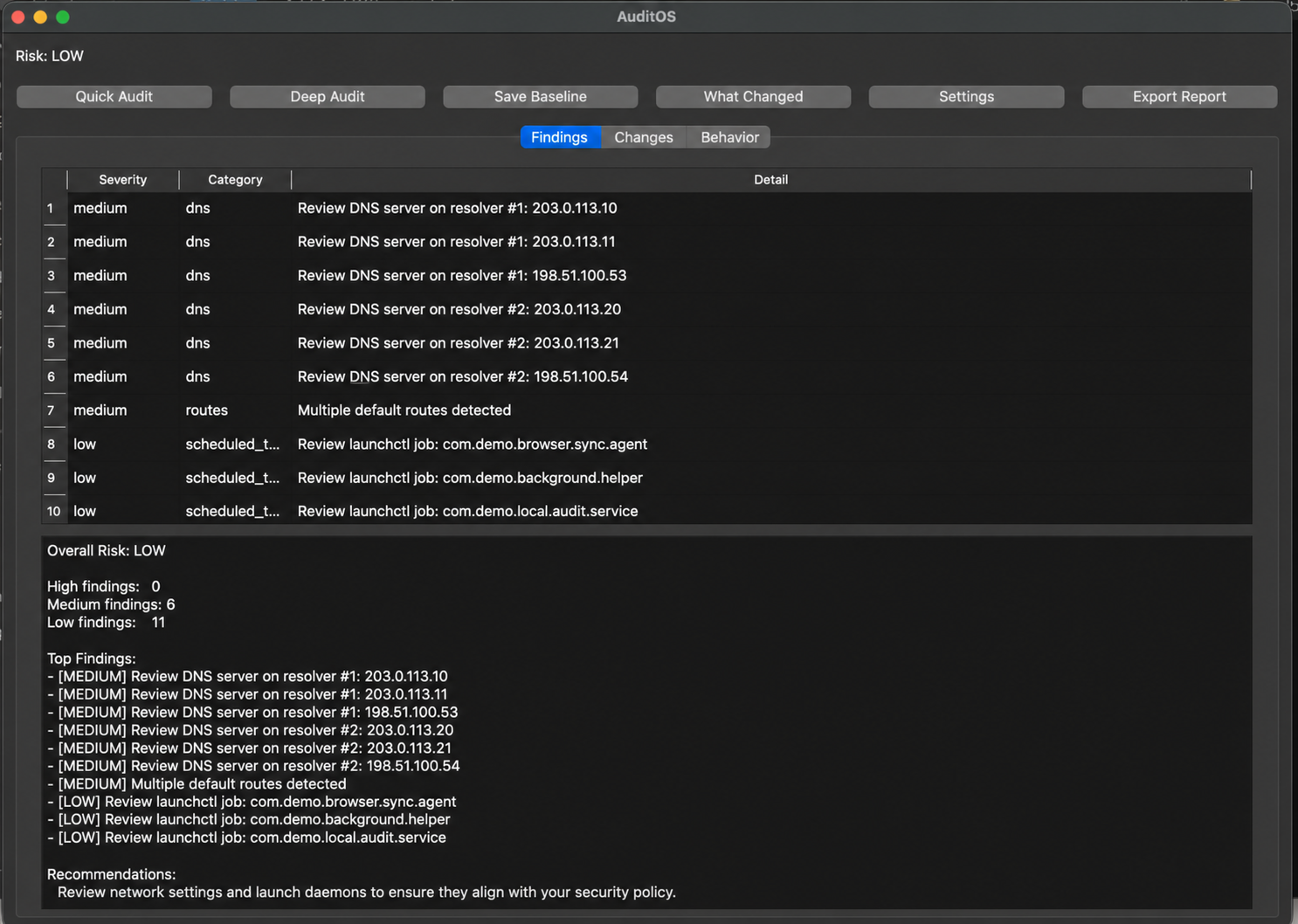
Shows the primary findings view with categorized results, overall risk, and follow-up recommendations after a local audit run.
Shows the behavior review workspace where observed connections can be sorted and reviewed from the main desktop interface.
Shows a baseline review state where DNS entries, startup items, and scheduled items can be compared over time from one structured view.
Highlights the onboarding flow that explains local-only scans, terms acknowledgement, and the app’s non-destructive approach before use.
How the project is structured behind the interface.
AuditOS is built as a local-first desktop application with a modular audit structure. The project is designed so additional audit checks can be expanded over time while keeping the user experience readable and approachable.
Python desktop application
The core application logic lives in Python so the tool can stay practical to iterate on while supporting real audit workflows.
PySide6 interface
The UI is built as a desktop-first interface designed to keep findings readable and user actions straightforward.
Modular audit components
Audit checks are organized so the project can grow over time without turning every new capability into a structural rewrite.
Local-first processing
Scans are designed to run on the user’s machine rather than depending on a remote service for routine analysis.
GitHub-based release workflow
The public repository and release structure support versioned testing, packaging, documentation, and broader feedback.
Privacy and security focused reporting
Reporting is shaped to make technical findings understandable without hiding the security or privacy implications.
Browser setup risk is real, but most people never get a clear read on it.
Most users do not have an easy way to understand what their browser setup may expose, how extensions or settings may affect privacy, or where common security gaps may exist. AuditOS was created as a practical tool to make that kind of review more understandable.
Building the tool also meant building the project around it well.
- Structuring the app so audits could be expanded over time.
- Packaging a desktop app cleanly.
- Balancing technical detail with non-technical usability.
- Organizing the project for future contributors and testers.
The project improved both the software and the way I present it.
- Better software structure.
- Release management.
- Dependency handling.
- How to present a technical project publicly.
- The importance of clear documentation and user trust.
Technical and product strengths visible in the work.
The project shows a mix of software implementation, troubleshooting, delivery planning, and privacy-minded product judgment.
Early development, with public testing in view.
AuditOS is currently in early development/testing. It is being prepared for public testing through GitHub releases.
Current phase
Core project structure and testing readiness are still being developed.
Release path
GitHub releases are the intended path for public testing and early distribution.
Why it matters
The project is being built to feel trustworthy, understandable, and useful from the first public version onward.
Follow the project as it moves toward public testing.
AuditOS is being shaped as a real technical project with a public repository, release path, and room to grow.